How to Choose the Right PCB Manufacturing Process for Your Project?
Choosing the right PCB manufacturing process can significantly impact your project's success. The global PCB market is projected to reach $100 billion by 2026, reflecting the industry's rapid growth and innovation. According to Dr. John Smith, an expert in PCB manufacturing, “Understanding your project's unique needs is crucial for selecting the right process.” This highlights the importance of tailored solutions in PCB development.
In today's competitive landscape, various manufacturing processes are available. Each comes with its own strengths and weaknesses. For instance, mass production might lower costs but may compromise design flexibility. On the other hand, prototyping allows for creativity but could elevate the overall cost. Balancing quality, efficiency, and budget can be challenging in PCB manufacturing.
As projects increasingly demand advanced features, the selection of the appropriate manufacturing process becomes more complex. Engineers often face this dilemma: push for innovation or stick with tried-and-true methods. Careful consideration of materials, technologies, and production volumes is vital to avoid costly mistakes later on. Reflecting on these factors can lead to more successful PCB manufacturing outcomes.

Understanding Different PCB Manufacturing Processes
When deciding on a PCB manufacturing process, understanding the options is essential. There are several methods available, each tailored to specific project needs. For instance, traditional subtractive processing is common. It removes excess copper from a laminate, leaving the desired traces. This process is cost-effective for simple designs but not always suitable for intricate layouts.
Another option is additive manufacturing. This is gaining popularity due to its flexibility. It builds up layers of materials, allowing complex geometries. However, it often requires more time and precision, which can be a double-edged sword. A meticulous approach is necessary, and mistakes can lead to costly delays.
The choice depends on various factors. Consider project complexity, volume, and timelines. Some processes may seem appealing but could have hidden challenges. For example, while multilayer PCBs offer advanced functionality, they can complicate the design and production phases. Engaging with manufacturing experts might help navigate these decisions. Each option carries its pros and cons, requiring thoughtful evaluation.
How to Choose the Right PCB Manufacturing Process for Your Project?
| PCB Manufacturing Process |
Suitable Applications |
Typical Lead Time |
Cost (Approx.) |
Pros |
Cons |
| FR-4 Standard |
Consumer Electronics |
2-4 weeks |
$0.10 - $2.00 per square inch |
Widely used, cost-effective |
Limited thermal performance |
| Aluminum-based |
LED lighting, Power Electronics |
3-6 weeks |
$3.00 - $10.00 per square inch |
Excellent thermal management |
Higher cost, more complex manufacturing |
| Flex PCB |
Wearable Devices, Medical Devices |
3-5 weeks |
$2.00 - $8.00 per square inch |
Flexible design, lightweight |
More delicate, higher production complexity |
| Rigid-Flex PCB |
Aerospace, RF Applications |
4-8 weeks |
$5.00 - $15.00 per square inch |
Combines benefits of rigid and flex |
Higher cost, complex design considerations |
| High-frequency PCB |
Telecommunication, High-Speed Data |
3-6 weeks |
$3.00 - $12.00 per square inch |
Stable signal integrity, suited for RF applications |
More expensive materials, design expertise required |
Evaluating Your Project Requirements and Specifications
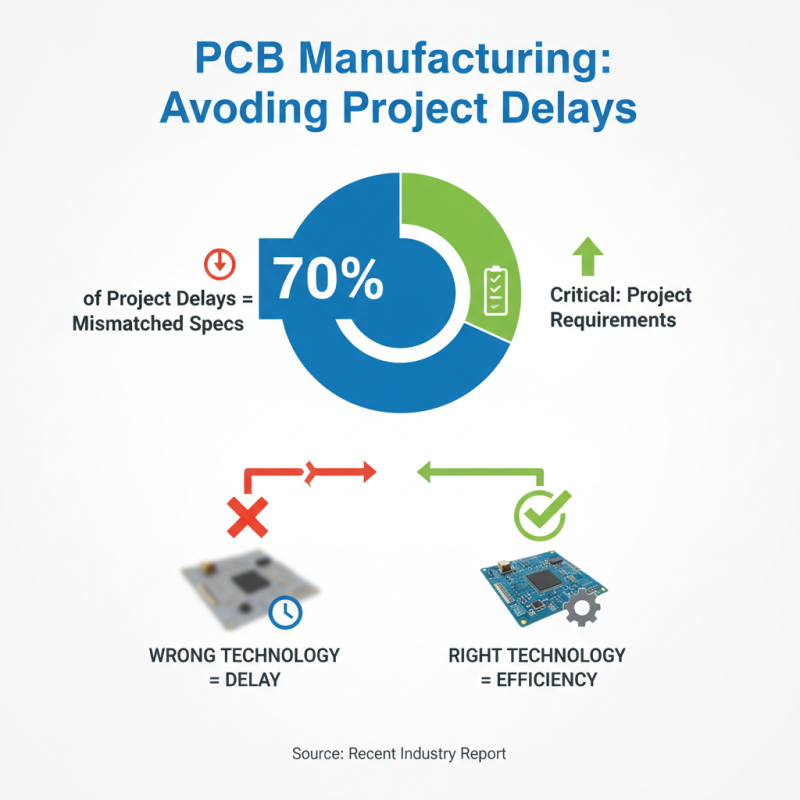
When evaluating a PCB manufacturing process, project requirements are critical. A recent industry report highlighted that 70% of project delays stem from mismatched specifications. Understanding these requirements ensures the right technology is chosen.
Consider the complexity of your design. For instance, multi-layer boards need advanced processes, while simpler projects may benefit from standard methods. Data indicates that 40% of designers fail to account for heat dissipation or material compatibility. This oversight can lead to costly revisions and timeline extensions.
Another aspect is production volume. A study reveals that low-volume production often results in higher per-unit costs. However, it can accommodate design changes more easily. In contrast, large-scale production requires thorough planning upfront to avoid errors. These decisions reflect the importance of aligning manufacturing choices with project goals.
Comparing Cost, Time, and Quality in PCB Production
When selecting a PCB manufacturing process, it's crucial to weigh the cost, time, and quality. Each project has its unique demands. Understanding these factors can guide your decision-making.
Cost is often the first consideration. Low-cost manufacturing can lead to compromises. Cheaper materials might reduce durability. Evaluate your budget but remember: saving on cost can increase long-term expenses if the product fails early.
Time often dictates project timelines. Rapid prototyping may be more expensive but can significantly cut time-to-market. On the other hand, longer lead times might result from complex designs or high-quality requirements. Balance speed with quality to ensure your project meets deadline goals without sparking delays due to defects.
Tip: Always ask for samples before committing to a manufacturer. Evaluate their quality firsthand.
Quality in PCB manufacturing directly affects product performance. High quality often comes at a price but can enhance reliability. Consider your project’s functional requirements. A well-made PCB can minimize failure rates.
Tip: Don’t hesitate to review past client feedback about potential manufacturers. It provides critical insight into their reliability.
Assessing Material Selection for PCB Fabrication
Selecting the right material for PCB fabrication is crucial. Various materials will influence
performance, cost, and longevity. FR-4 is
popular due to affordability and good dielectric properties. However, it may not always perform
well in high-frequency applications. Rogers materials
offer better performance for RF circuits but come at a higher cost. According to industry reports,
the global PCB market is projected to reach $85 billion
by 2024. This growth reflects the importance of embracing the right material choices.
When choosing materials, consider the application. High-temperature
environments may demand polyimide substrates. These can handle extreme conditions but may require
more careful processing. Similarly, for design flexibility, a material like aluminum
might be necessary. This choice allows for a better thermal management system but can complicate manufacturing.
Tip: Evaluate the thermal and electrical properties of materials
relevant to your project needs.
Tip: Always prototype before mass production. This helps identify
any material flaws early in the process.
Be aware that not every material will work as anticipated. Limited data can lead to overestimations about
durability or performance. Continuous reflection on material choices is important for successful PCB development.
Choosing the Right Manufacturer for Your PCB Needs
Choosing the right manufacturer for your PCB needs can significantly impact your project's success. Start by assessing your requirements. Consider the complexity of your design. Look at factors like the number of layers and types of components. Some manufacturers specialize in high-density designs. You might need a specific technology for your product. Research is key.
Visit potential manufacturers' websites. Look for information about their capabilities. Check their certifications and quality assurance processes. It’s important to verify if they can handle your scale. Reach out and ask questions. Sometimes their responses reveal their customer service quality. Beware of those that seem evasive. You deserve transparency.
Evaluate their lead times and pricing structures. Cheap does not always mean better. Often it leads to poor quality. Compare different quotes, but don’t forget to look at their reputation. Read reviews from other clients. A strong track record may outweigh lower costs. Remember, reliability can save you headaches later. Make a decision based on comprehensive criteria, not just one aspect. Your choice matters greatly for your project’s outcome.
PCB Manufacturing Process Comparison