2026 Best Motor Control Types for Global Buyers?
Choosing the right motor control in 2026 requires more than comparing purchase prices. Global buyers must match control technology with motor size, load behavior, voltage, frequency, and operating environment. A conveyor in a dusty warehouse needs different protection from a pump in a clean processing room. Small details matter.
This guide examines direct-on-line starters, star-delta systems, soft starters, variable frequency drives, servo drives, and intelligent motor starters. Each option affects starting current, torque, energy use, maintenance, and machine response. A direct-on-line starter remains practical for simple, stable loads. A variable frequency drive offers stronger speed control, but it may require careful electromagnetic compatibility planning. Servo systems deliver precision, yet their cost and setup demands can challenge smaller operations.
Real purchasing experience shows that specifications alone can mislead. A low-cost unit may create higher expenses through downtime, spare parts, or difficult commissioning. Supplier documentation, regional certifications, after-sales support, and replacement availability deserve equal attention. Buyers should verify enclosure ratings, thermal protection, communication protocols, and compatibility with local electrical standards. Ask for test records.
No single type wins everywhere. Even experienced engineers can overlook cable length, ambient heat, or frequent load changes. This comparison therefore treats motor control as a practical engineering decision, not a universal ranking. The most reliable choice balances performance, safety, serviceability, and long-term operating value. Some conclusions may change as standards and technologies develop.
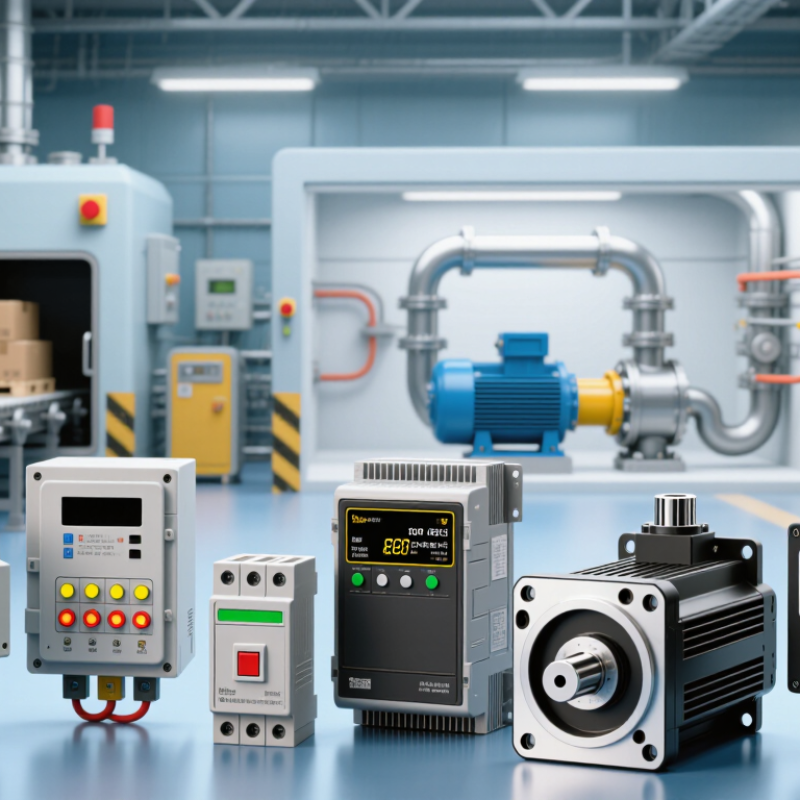
Motor Control Fundamentals and Key Performance Terms
Choosing motor control starts with motor behavior, not a catalog label. A contactor suits simple on/off duty, while a soft starter reduces starting shock. A variable frequency drive adjusts frequency and voltage to control speed and torque. Servo control adds precise feedback for positioning, but it demands careful tuning. The right choice depends on load inertia, starts per hour, speed range, and stopping needs. That sounds obvious. Confirm local supply voltage, frequency, and enclosure requirements before purchasing equipment.
During commissioning, measure line voltage, running current, acceleration time, and cabinet temperature. Compare measured current with the motor’s rated full-load current, not only the controller display. Key terms need practical meaning: torque turns the shaft; speed is rotational rate; power combines both. Duty cycle describes how long the motor runs and rests, while overload capacity shows short-term strength. Efficiency indicates useful output versus electrical input, and power factor describes how effectively current is used. These values interact.
A closed-loop system uses feedback to correct speed or position errors; an open-loop system cannot see them directly. Response time matters when a conveyor must stop within a fixed distance. Protection terms matter too: overload protection, short-circuit coordination, braking method, and ingress protection rating. I have seen a technically correct selection run too hot because ventilation was treated as an afterthought. That mistake is easy. Ambient temperature, cable length, harmonics, and maintenance skill can change field performance. My own selection sheets are not perfect; I now leave space for verified measurements and operator feedback.
2026 Best Motor Control Types for Global Buyers? – Motor Control Fundamentals and Key Performance Terms
| Motor Control Type | Control Fundamentals | Typical Motor Applications | Starting Current | Speed Regulation | Energy Performance | Torque Control | Main Advantages | Key Limitations | Best Buyer Priority |
|---|---|---|---|---|---|---|---|---|---|
| Direct-On-Line (DOL) Starter | Connects the motor directly to the fixed-frequency supply through a contactor and overload relay. | Fans, pumps, compressors and conveyors with low or moderate starting requirements. | Typically about 5–8 times rated current for standard induction motors. | Fixed speed; normally follows the supply frequency with operating slip. | High electrical simplicity, but no speed-based energy saving. | High starting torque, determined mainly by motor design and supply conditions. | Lowest initial complexity, easy maintenance and broad global availability. | High inrush current, mechanical shock and limited process control. | Lowest purchase cost and simple fixed-speed operation. |
| Star-Delta Starter | Starts the motor in star connection and changes to delta after acceleration to reduce line current. | Medium-size pumps, fans and lightly loaded compressors with suitable six-terminal motors. | Approximately one-third of DOL starting line current under ideal conditions. | Fixed speed after transition; no continuous speed adjustment. | Lower starting demand, but limited energy savings during normal operation. | Starting torque is also approximately one-third of DOL torque. | Reduces supply disturbance and uses relatively simple hardware. | Not suitable for high breakaway loads; transition can create torque or current transients. | Reduced starting current without requiring variable-speed control. |
| Soft Starter | Uses controlled semiconductor switching to gradually increase motor voltage during starting and stopping. | Pumps, fans, conveyors, crushers and applications requiring smooth acceleration. | Adjustable and generally lower than DOL, depending on ramp settings and load torque. | Normally fixed speed after startup; some units provide limited control functions. | Low running losses when bypassed; limited energy-saving capability compared with a VFD. | Good acceleration control, but weak low-speed torque control. | Reduces mechanical stress, water hammer and voltage dips during starting. | Cannot provide full-range speed control or high-performance low-speed operation. | Smooth starting and stopping for fixed-speed systems. |
| Variable Frequency Drive (VFD) | Converts AC to DC and back to variable-frequency, variable-voltage AC using power semiconductors and pulse-width modulation. | Pumps, fans, conveyors, HVAC systems, mixers, extruders and machine tools. | Can be limited close to the motor’s rated current through programmed acceleration. | Typically ±0.5–2% with basic control; better with vector control and feedback. | Strong potential for savings in variable-torque loads; affinity laws apply to centrifugal pumps and fans. | Basic V/f control offers moderate torque; sensorless or closed-loop vector control provides stronger torque performance. | Wide speed range, programmable ramps, protection functions and process integration. | Higher cost, electromagnetic interference, harmonic current and possible motor insulation stress. | Variable speed, energy efficiency and flexible process control. |
| Sensorless Vector Drive | Estimates rotor position and motor flux from electrical measurements without a mechanical encoder. | Conveyors, hoists with appropriate configuration, mixers, machine tools and constant-torque loads. | Usually programmable and controlled near rated current during acceleration. | Often around ±0.5–1% under suitable motor tuning and operating conditions. | Efficient across changing loads, although drive losses remain present. | Improved low-speed torque and dynamic response compared with basic V/f control. | Good performance without encoder installation or encoder wiring. | Performance decreases near zero speed and depends on accurate motor parameters. | Higher torque performance without a feedback device. |
| Closed-Loop Vector Drive | Uses encoder or resolver feedback to regulate motor speed, position and torque in real time. | Hoists, winding lines, elevators, precision conveyors and demanding production machinery. | Precisely managed through current and torque limits. | Often better than ±0.1% with suitable feedback, tuning and mechanical conditions. | High control efficiency; total system efficiency also depends on feedback hardware and load profile. | Excellent torque regulation, including strong low-speed and near-zero-speed control. | High dynamic response, accurate speed holding and reliable load handling. | Higher system cost, commissioning effort and feedback wiring requirements. | Precision, dynamic response and controlled torque. |
| Servo Drive and Servo Motor | Closed-loop position, speed and torque control, normally using a permanent-magnet synchronous motor and high-resolution feedback. | Robotics, packaging, printing, semiconductor equipment and precision motion systems. | Controlled electronically; peak current is available for short-duration acceleration. | Very high; commonly specified by encoder resolution, bandwidth and positioning accuracy. | High motor efficiency and strong dynamic efficiency when correctly sized. | Precise continuous torque control with rapid response. | Accurate positioning, fast acceleration and coordinated multi-axis motion. | Highest cost and greater requirements for tuning, feedback, cabling and thermal design. | Precision motion and rapid dynamic performance. |
| Stepper Motor Driver | Commands motor movement in discrete electrical steps; open-loop systems may operate without position feedback. | Light-duty positioning, laboratory equipment, small automation systems and 3D motion platforms. | Current is electronically limited; input current depends on driver design and operating speed. | Good at low speed; accuracy can decline if steps are lost or the load exceeds available torque. | Can consume significant current at standstill; efficiency generally falls at higher speed. | High holding torque, but available torque decreases as speed rises. | Simple motion control, strong holding torque and no feedback required in basic applications. | Resonance, audible noise, heat generation and possible position loss in open-loop operation. | Economical low-speed positioning. |
| BLDC Motor Controller | Electronic commutation switches current between motor phases using Hall sensors or sensorless back-EMF estimation. | Small pumps, fans, appliances, battery equipment, light electric mobility and compact automation. | Electronically limited and generally lower than uncontrolled direct connection. | Good with Hall feedback or closed-loop control; sensorless operation needs adequate speed for estimation. | High efficiency because there are no mechanical brushes; system efficiency varies with controller and load. | Good continuous torque, with ripple depending on motor geometry and commutation method. | Compact design, low maintenance, high efficiency and long operating life. | Requires compatible electronic control, thermal management and electromagnetic compatibility design. | Compact, efficient and brushless operation. |
Rated Voltage: The continuous voltage for which the motor and controller are designed. Rated Current: The continuous current associated with the motor’s rated operating condition. Rated Power: Mechanical output power available at the specified speed and duty. Rated Torque: Continuous shaft torque under the stated operating conditions. Peak Torque: Short-duration torque available for acceleration or transient loads. Speed Range: The allowable operating-speed range while maintaining required torque and cooling. Duty Cycle: The defined pattern of load, speed, operation and rest periods. IP Rating: The enclosure’s resistance to solid particles and water ingress under standardized tests. Efficiency: The ratio of mechanical output power to electrical input power. Power Factor: The relationship between real power and apparent power in an AC system. Harmonic Distortion: Waveform distortion caused by nonlinear power electronics and switching devices. EMC: The ability of equipment to operate correctly without causing or suffering unacceptable electromagnetic interference.
Related Posts
-
What Is Motor Control and What Types Are Available?
-

Understanding the Basics of Motor Control: How Your Brain Coordinates Movement
-

Unlocking the Mysteries of Motor Control: How Your Brain Powers Movement
-

2025 Guide: How to Improve Motor Control for Better Performance
-

Top 10 Tips for Sourcing Semiconductor Machines Effectively
-
Exploring the Advantages of Direct Drive Linear Motors in Modern Technology?